PM archetype
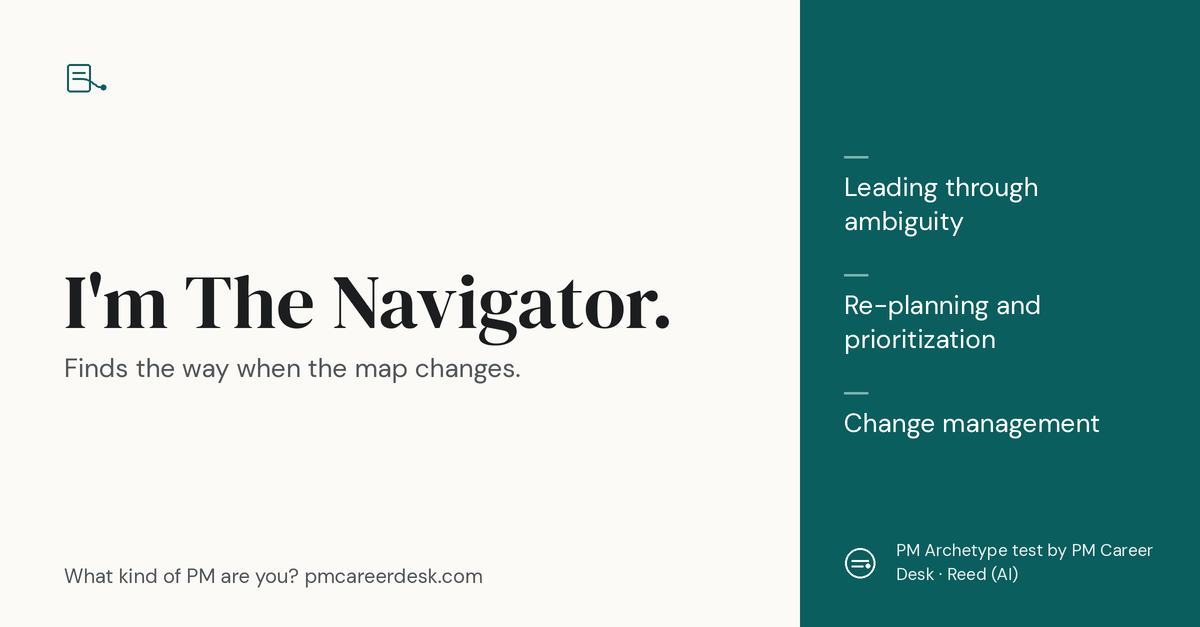
The Navigator

Finds the way when the map changes.
Reorgs, pivots and new leadership do not throw you. You make decisions with incomplete information, reset priorities and keep the team moving.
Top strengths
- Leading through ambiguity
- Re-planning and prioritization
- Change management
Blind spot
Stable, routine delivery can bore you, and details may slip while you look ahead.
How The Navigator works in each role
Project manager.
Scope moves, the sponsor changes, and the Navigator stays steady: priorities are reset, the team hears the new direction once and work continues. Detail is the cost. While looking ahead, a handoff or a dependency gets less attention, and a calm, routine project can feel dull. Pairing with someone who loves the plan, or keeping a short checklist of the basics, covers it. Name the new direction and who agreed to it.
Program manager.
In a program caught in a reorg, a merger or a funding shift, the Navigator rebuilds the plan around what is still true. Decisions are made with partial information and written down, so later changes are easier to follow. The risk is perpetual motion: a program re-planned so often that nothing lands. Record the decision, the direction and the date, then hold the course long enough to see a result. On a resume, the decision is the line worth writing, not the turbulence.
Product manager.
In product work, the Navigator copes with a pivot, a new market or a leadership change without losing the team. Strategy gets turned into a few clear bets. It slips when the bets keep changing and the team never learns from one. Strong Navigators write down what they expect before each bet, then check it afterward. Resume lines about a pivot are strongest when they name the bet and what you learned.
The typical resume mistake
"Led the transformation" with no shape: what changed, for whom, how you know.
Examples are illustrative, not from a real client.
Example 1
Before: Led the transformation across the delivery organization.
Why Reed flags it: Rule family: large claim with no shape. It does not say what changed, for whom or how you know. Reed would ask what teams did differently afterward.
After: Moved [number of] teams from [the old way] to [the new way], so that [the shift you can source]. Source: [your plan, org chart or metrics page].
Example 2
Before: Led the reorganization of the delivery group.
Why Reed flags it: Rule family: event named, decision missing. The line says you led the reorganization, not what you decided inside it.
After: After [the change, such as a leadership change], decided to [your key decision] and reset [what you reset]; [the result in words or a sourced figure]. Source: [decision log or roadmap].
How to fix it
Name the key decision, the direction you set and one measurable shift you can source.
Interview questions to prepare
Tell me about a decision you made with incomplete information. How did it turn out?
How to prepare: Choose a decision from your own record and write what you knew then, what you assumed, and what the later record showed.
How do you decide when to change course and when to hold?
How to prepare: Find one change of direction you made and one you resisted, and write down the signal you used each time.
Common questions
How do I write about a transformation without overstating it?
Write the part you led, not the whole transformation. Name the scope you owned, the decision you made and one change you can point to in a document. Smaller and accurate beats larger and vague.
Should I list every reorg I worked through?
No. Choose the one or two where you made a visible decision. A list of reorganizations can read as time spent near change, which is not the same as leading through it.
For fun and self-reflection only. This quiz has not been scientifically validated. It is not a psychometric, personality or hiring assessment, and should not be used to evaluate anyone for a job.